
2026 Best Door With Sidelights for Global Buyers?
Choosing the 2026 Best Door With Sidelights requires more than comparing photographs and showroom prices. Global buyers need to assess security, daylight, insulation, weather resistance, maintenance, and installation quality together. A beautiful oak door can still perform poorly beside a windy coastline.
The International Energy Agency reports that buildings consume about 30% of global final energy and create roughly 26% of energy-related emissions. This makes thermal performance a practical buying issue, not merely a design preference. Insulated cores, low-emissivity glazing, effective weatherstripping, and suitable U-factor values deserve close attention. The U.S. Department of Energy also identifies air leakage and weak installation as major causes of comfort loss. The frame matters too.
Industry guidance from the Window and Door Manufacturers Association and the National Fenestration Rating Council supports checking air, water, structural, and thermal performance. However, ratings from one climate zone may not translate perfectly to another. A door designed for a dry inland city may need different glazing and drainage details near tropical storms. Local building requirements must remain the final reference.
This guide compares common materials, glass configurations, locking systems, threshold designs, and supplier claims for international purchasing. It considers fiberglass, engineered wood, aluminum, and composite options. It also examines lead times, warranty wording, replacement parts, and professional fitting. These details often decide ownership costs.
No ranking is perfect. Product data can be incomplete. Some manufacturers publish impressive thermal figures without explaining test conditions, which deserves skepticism. Buyers should request certified performance documents, installation drawings, sample finishes, and project references before ordering. A sidelights package should welcome daylight without creating a cold, noisy, or vulnerable entryway.
What Are Doors With Sidelights and Why Do Global Buyers Choose Them?
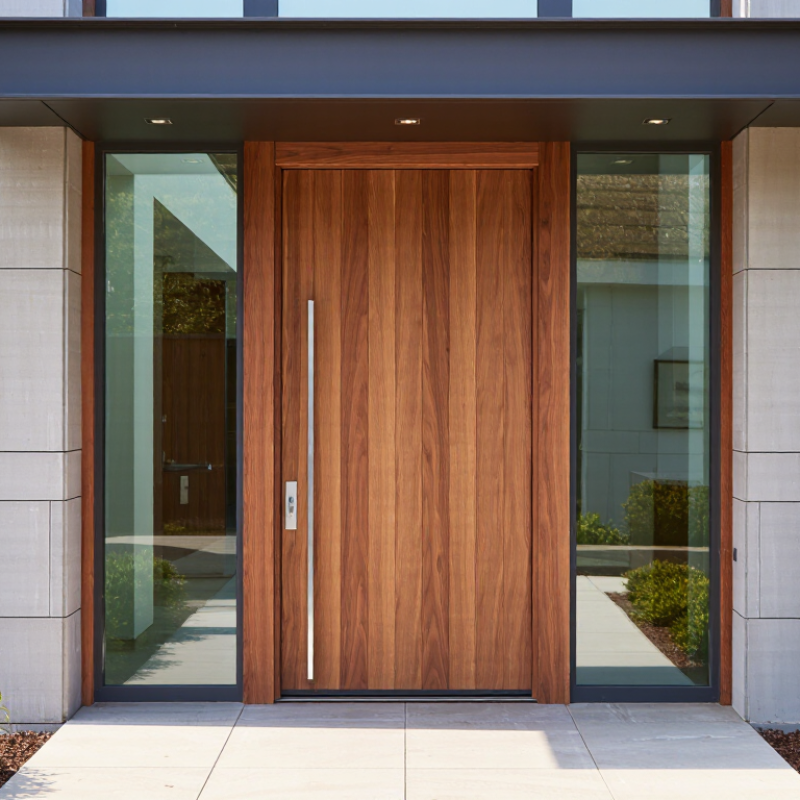
A door with sidelights combines a main entrance door with narrow glazed panels beside it. These panels can be fixed, operable, clear, frosted, or decorative. They extend the visual width of an entryway and bring daylight into darker halls.
That matters in compact apartments, villas, hotels, and renovated heritage homes. Global buyers often choose them because one entrance can feel brighter, wider, and more welcoming without removing a wall.
Performance needs more attention than appearance. The U.S. Department of Energy reports that windows can represent 25–30% of a home’s heating and cooling energy use. Sidelights are glazed areas, so weak frames or poor seals may increase heat transfer.
Ask suppliers for U-factor, solar heat gain coefficient, air-leakage results, and water-resistance testing. ENERGY STAR’s Residential Windows, Doors, and Skylights criteria also emphasize verified thermal performance.
In hot climates, lower solar gain may reduce indoor heat. In cold regions, insulated glazing and warm-edge spacers deserve priority. Local installation standards still matter.
More glass is not automatically better. A broad clear sidelight can improve daylight but reduce privacy and expose fingerprints. Laminated or obscured glass may solve that, although it can raise cost and weight.
I have seen attractive entrances feel uncomfortable when the handle, threshold, and drainage were treated as afterthoughts. Buyers should compare complete door assemblies, not isolated glass panels.
Sometimes a narrower sidelight performs better. That is easy to overlook.
Key Types, Materials, Glass Options, and Opening Configurations
Global buyers in 2026 should treat a door with sidelights as a complete entry system. Full sidelights create a broad, balanced opening. Half sidelights suit narrower porches and reduce exposed glass. A single sidelight works well beside an uneven wall or limited hallway. Double sidelights offer symmetry, but they require more clearance and careful structural planning.
Fiberglass resists moisture and usually needs less maintenance. Engineered wood provides warmth, yet its edges must be sealed properly.
Aluminum is slim and stable, though thermal performance depends on its insulated core and frame design. Solid wood feels substantial. It can still swell during humid seasons.
Glass selection affects security, daylight, privacy, and energy use. Low-emissivity double glazing suits many climates, especially with insulated frames. In cold regions, warm-edge spacers can reduce interior condensation. Tempered glass improves impact safety, while laminated glass remains bonded after breakage. Frosted, reeded, or acid-etched surfaces soften visibility without blocking all daylight. Clear glass feels welcoming, but it may expose an entry hall at night.
I once underestimated this detail on a bright showroom sample. Real homes need evening testing.
Opening configuration should match traffic, weather, and accessibility needs. Inswing doors save exterior space but consume interior floor area. Outswing systems preserve room space and can manage wind-driven rain when thresholds drain correctly. A hinged door offers familiar operation. A pivot door needs stronger framing and accurate alignment.
Sliding configurations save swing clearance, yet their seals and rollers deserve close inspection. Confirm rough-opening dimensions, handing, threshold height, local wind exposure, and delivery tolerances before ordering. Small measurement errors become expensive on site.
How to Compare Energy Efficiency, Security, Durability, and Maintenance
2026 Best Door With Sidelights for Global Buyers?
A strong comparison starts with the whole doorway, not the door slab alone. Sidelights can increase daylight, but large glass areas may raise heat gain and winter heat loss. Check the complete unit’s U-factor, air-leakage rating, and solar heat-gain coefficient. Lower U-factor usually means better insulation. However, climate matters more than a single attractive number. A low solar-gain rating suits hot regions, while colder areas may benefit from controlled winter sunlight.
Security depends on the frame, glass, hinges, lock, and installation. Laminated sidelights resist impact better than ordinary glass because the inner layer holds fragments together. A reinforced frame and long screws should connect securely with structural framing. Multi-point locking can reduce edge movement, but poor alignment will weaken its value. Test the latch after installation. It should close smoothly without forcing the handle.
Durability is often decided by small details. Look for sealed joints, corrosion-resistant hardware, a thermally broken threshold, and replaceable weatherstripping. In coastal areas, salt exposure demands more frequent cleaning and hardware checks. In wet climates, inspect the lower frame for swelling, staining, or trapped water. Maintenance instructions should be clear and locally practical. I would not trust a door based only on laboratory ratings; installation quality can change real performance. No design suits every climate. Buyers should compare certified test data with local building requirements, then inspect samples under realistic light, wind, and temperature conditions.
What Sizes, Standards, and Installation Requirements Should Buyers Check?
For global buyers, a door with sidelights is more than a decorative entrance. It is a measured system involving the door leaf, glass panels, frame, threshold, and wall opening. The U.S. Department of Energy reports that windows account for about 25%–30% of residential heating and cooling energy use. Large sidelights can increase solar gain and heat loss. Ask for U-factor, solar heat gain coefficient, visible transmittance, and air-leakage results.
Sizes are not universal. A 36-inch door leaf does not provide a 36-inch clear opening after hinges, seals, and the frame are installed. In the United States, accessible routes generally require at least 32 inches of clear opening under the 2010 ADA Standards. European projects may reference EN 14351-1, while North American specifications often use NAFS, formally AAMA/WDMA/CSA 101/I.S.2/A440. Request documented air, water, and structural test results, not vague claims.
Installation details often decide performance. Confirm the rough-opening width, height, wall thickness, handing, threshold height, and drainage direction before production. The sill should include a compatible pan or flashing system, with shims supporting the frame at approved points. Keep the frame plumb and square. Small errors create binding or uneven sidelights. According to the IEA’s Energy Efficiency 2024 analysis, buildings remain responsible for roughly 30% of global final energy demand. That makes thermal detailing practical, not merely technical. I still see buyers trusting catalog dimensions too quickly. A factory-perfect unit can fail when the opening, flashing, or local code is misunderstood.
2026 Best Door With Sidelights for Global Buyers
Common nominal door widths shown below are used for early planning. Actual frame, sidelights, rough-opening, accessibility, fire-rating, and egress requirements must be confirmed against the destination country's building code and the selected door system.
How to Select a Reliable Manufacturer and Evaluate Total Purchase Costs
Choosing a door with sidelights for global projects requires more than comparing catalog prices. The manufacturer should explain frame materials, glass options, moisture resistance, and hardware grades clearly. Ask for production photos, sample details, inspection records, and recent customer references. A reliable supplier welcomes specific questions.
Request a physical sample when possible. Check the sill, corner joints, weather seals, hinges, and glass edges by hand. These small areas often reveal poor workmanship. Confirm whether the factory performs dimensional checks before packing. Review test reports and product specifications against the building requirements in your target market. Do not accept vague claims such as “premium quality.” Evidence matters more.
The total purchase cost includes far more than the door price. Calculate sidelights, custom sizes, protective packaging, inland transport, ocean freight, insurance, taxes, installation, and possible replacement parts. A lower quote can become expensive after special crating or unexpected port charges. Get every cost in writing. Also confirm production time, payment milestones, warranty coverage, and how damaged units are handled. I once focused too heavily on the unit price and underestimated installation adjustments. That mistake changed the real budget. Leave room for measurement errors and schedule delays. A serious manufacturer will discuss these risks instead of promising perfection.
